Greenville vs Raleigh: North Carolina Wins the Income Tax Argument and Still Costs You $2,100 a Year
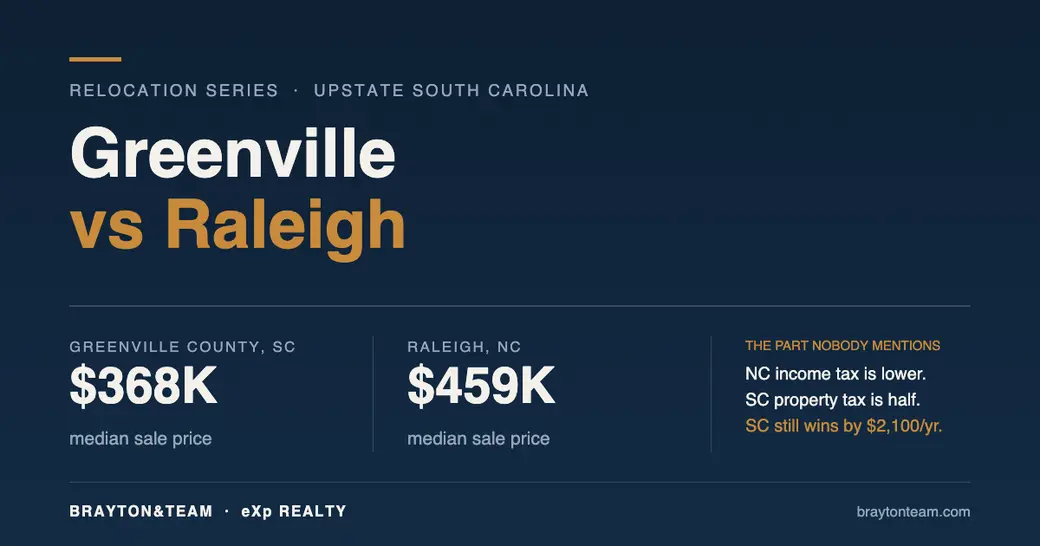
North Carolina's income tax is lower than South Carolina's. That's true if you earn a Raleigh salary, and almost every relocation article gets it backwards. Then Wake County sends the property tax bill and the whole comparison flips. Here's the arithmetic nobody runs for you.
Greenville vs Raleigh at a glance
| Greenville, SC | Raleigh, NC | |
|---|---|---|
| Median home sale price | $368,146 (Greenville County) | $459,000 |
| Median household income | $76,900 | $85,395 |
| Price to income ratio | 4.8x | 5.4x |
| State income tax (2026) | 5.21% minus a $966 credit | Flat 3.99% |
| Property tax on the median home | about $1,804/yr | about $4,173/yr |
| Cost of living | Baseline | 14.0% higher |
| Same job pays | Baseline | 6.0% more |
| Distance | Home | 266 miles, about 4 hours |
The Raleigh property tax bill is the number nobody puts in the brochure
North Carolina taxes your house at full market value. South Carolina assesses an owner-occupied primary residence at 4% of market value, which is one of the lowest ratios in the country.
That single difference does most of the work.
For the fiscal year that started July 1, 2026, Wake County's rate is 53.71 cents per $100 of assessed value and the City of Raleigh's is 37.2 cents. Combined, that's 90.91 cents, or 0.9091%. On Raleigh's $459,000 median sale price, you're looking at roughly $4,173 a year.
The Tax Foundation puts South Carolina's effective rate on owner-occupied housing at 0.49%. On Greenville County's $368,146 median, that's about $1,804.
Difference: $2,369 a year. Call it $197 a month, every month, before you've paid a dime of principal.
And both Wake County and the City of Raleigh raised their rates this year. Wake added two cents. Raleigh went up as part of a $1.77 billion budget. So Raleigh homeowners got a higher tax bill in the same twelve months the market softened underneath them.
Verify your own numbers with a CPA before you build a budget on any of this.
North Carolina's income tax genuinely beats South Carolina's, above about $79,000
Here's the part competing relocation posts skip, because it doesn't help the South Carolina pitch.
South Carolina rewrote its income tax in March 2026 with H.4216. The structure is 1.99% on the first $30,000 of taxable income and 5.21% above that, which the SCDOR describes as a flat 5.21% with a $966 credit. North Carolina is a flat 3.99% for 2026, on its way down to 2.49% by 2029.
Run the two side by side and they cross at roughly $79,000 of taxable income. Below that line, South Carolina is cheaper. Above it, North Carolina wins.
Raleigh's median household income is $85,395. RTP salaries run well past that. So for a lot of the people actually moving to Raleigh, North Carolina's income tax really is the better deal.
At $100,000 of taxable income, North Carolina saves you about $254 a year.
Then the property tax takes back $2,369.
Net position: South Carolina, by roughly $2,100 a year. The income tax argument is real. It's just nine times too small to matter.
That $79,000 crossover is my own math off the two published rate structures, not a published figure. Treat it as directional and check it with your accountant.
Greenville vs Raleigh home prices: $90,000 apart, and Raleigh is the one cooling
Redfin has Raleigh's median sale price at $459,000, up 1.8% year over year. Greenville County sits at $368,146, up 0.4%.
That's a $90,854 gap. About 25%.
But look at what each market is doing right now, because they are not doing the same thing. The Raleigh-Cary metro had roughly 5,787 active listings in June 2026, the deepest selection Triangle buyers have had since 2020. Year to date, the metro's median sale price is $435,775, down 3.2%. Realtor.com clocked active listings up nearly 18% year over year in March with median list prices off more than 5%. Homes are sitting 43 days and closing at 98.44% of ask.
Which means if you want Raleigh, this is the best negotiating position buyers have had there in six years. I'd rather tell you that than pretend Greenville wins on every line.
Greenville, meanwhile, is doing what Greenville does. Up slightly. Boring. Boring has been a decent strategy.
The price-to-income ratio is the other thing worth sitting with. Raleigh: 5.4x. Greenville County: 4.8x. Raleigh pays more, and the houses eat more of it.
Jobs, commutes, and what a 6% raise actually buys
Raleigh's economy is a genuine draw, and it's the honest reason most people go. Research Triangle Park holds close to 400 companies and 55,000 workers with a $25.1 billion annual impact. SAS employs nearly 14,000. Cisco is Wake County's largest manufacturer at about 3,400. Add Duke Health, state government, and the Wake County Public School System and you have a deep, diversified job market that Greenville does not match on scale.
Wake County is growing by about 66 people a day. More than 103,000 added since 2020, and last year it ranked among the top seven counties in the nation for raw population gain.
Greenville's economy runs on different fuel: Michelin's North American headquarters, BMW forty minutes east in Spartanburg, Prisma Health, and a manufacturing base that doesn't move when a tech hiring cycle turns.
Now the number that decides it for most families. Salary.com says the same job at a comparable company pays 6.0% more in Raleigh while costing 14.0% more to live there. Projected change to disposable income: down $4,796 a year.
A raise you lose money on is still a raise. It's a worse one.
Who should pick Raleigh over Greenville
Pick Raleigh if RTP is where your career actually lives. If you're in pharma, biotech, enterprise software, or academic research, Raleigh isn't a lifestyle preference, it's a job market, and Greenville can't replace it. No amount of property tax savings fixes a career you had to leave behind.
Pick Raleigh if you want RDU. Nonstop options out of Raleigh-Durham beat GSP, and if you fly weekly that's real time back.
Pick Raleigh if you want a bigger city with a bigger city's problems and a bigger city's Saturday nights. Greenville is walkable and charming in a way Raleigh isn't trying to be, but it's smaller, and some people feel that in six months.
And pick Raleigh if you're buying in the next few months and you want leverage. That inventory number is not going to sit there forever.
Greenville vs Raleigh FAQ
Is Raleigh or Greenville, SC cheaper to live in?
Greenville. Salary.com puts Raleigh 14.0% higher on cost of living while paying only 6.0% more for the same role, a projected $4,796 hit to annual disposable income. Housing and property tax drive most of the gap.
Is North Carolina or South Carolina better for taxes in 2026?
Depends where the money comes from. North Carolina's flat 3.99% income tax beats South Carolina's structure above roughly $79,000 of taxable income. South Carolina's property tax is less than half of Raleigh's combined city and county rate, which usually more than erases it. Confirm both with a CPA.
How far is Greenville, SC from Raleigh, NC?
About 266 miles, roughly four hours of driving. Close enough to see family on a weekend. Too far to commute, and nobody should try.
Is 2026 a good time to buy a house in Raleigh?
Better than the last five years, if you're buying there. Inventory in the Raleigh-Cary metro is the highest since 2020 and the year-to-date median sale price is down 3.2%. Sellers are negotiating again. Ask your agent for this month's numbers before you act on any figure in this post, because market data ages fast.
Comparing a Raleigh offer against staying put, or against Greenville? Send me the salary number and the two zip codes you're weighing. I'll run the property tax and the actual monthly payment side by side so you're comparing the same thing instead of two different brochures. You'll get a real answer from me, not a drip campaign.
Gabby Brayton, Brayton&Team at eXp Realty.
Categories
Recent Posts